
Where Do Implant Patients Really Come From? Part II
Updated: Aug 4
As a dental professional, referrals will always be one of the most consistent pathways for patients to arrive in your chair, whether a colleague sends over someone who trusts their judgment, or a satisfied patient mentions your name to a friend. That said, the landscape has been changing.
In this second part of our series, we’re looking at another one of the most common implant patient journey paths: the self-directed search.
Journey Path #2 Self-Directed Search
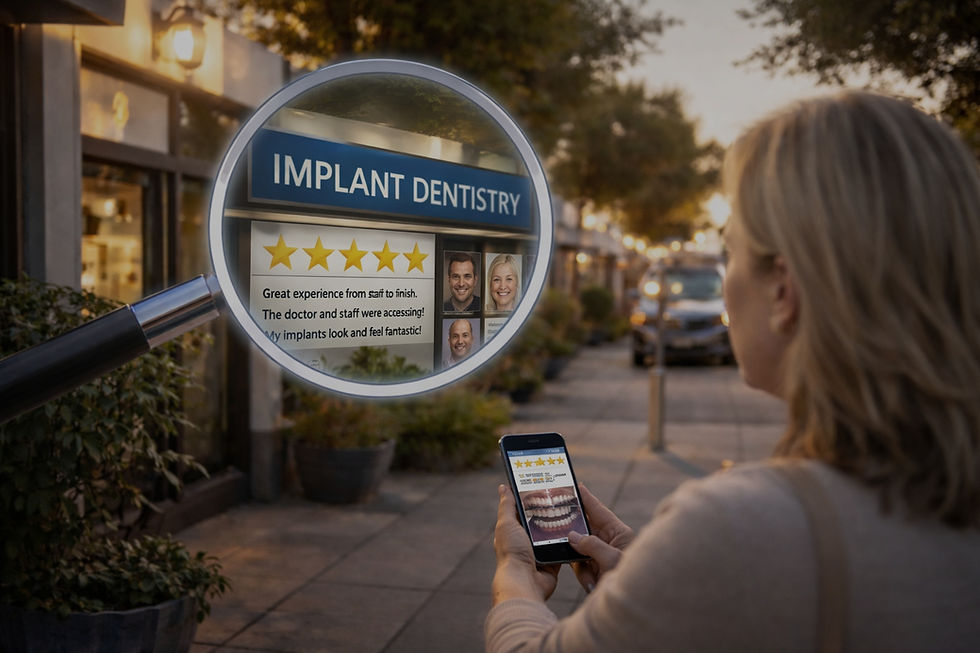
This is where patients take the initiative. They research options on their own, and gradually narrow their choices until they’re ready to reach out to a provider.
Increasingly, patients are starting their journeys long before anyone refers them. In fact, studies show that over 70% of dental patients search online before scheduling an appointment, and nearly 80% research a dentist online before contacting a practice.
What does this mean in practical terms? While referrals remain powerful, they're no longer the dominant starting point for many patients.
In modern times, we are seeing more patient journeys begin with a future patient sitting at home, opening a browser, typing a question into Google, watching a video, reading reviews, and comparing providers online. By the time they contact a practice, they often already have a working understanding of their problem and the solutions available.
The path of Self-Directed Search
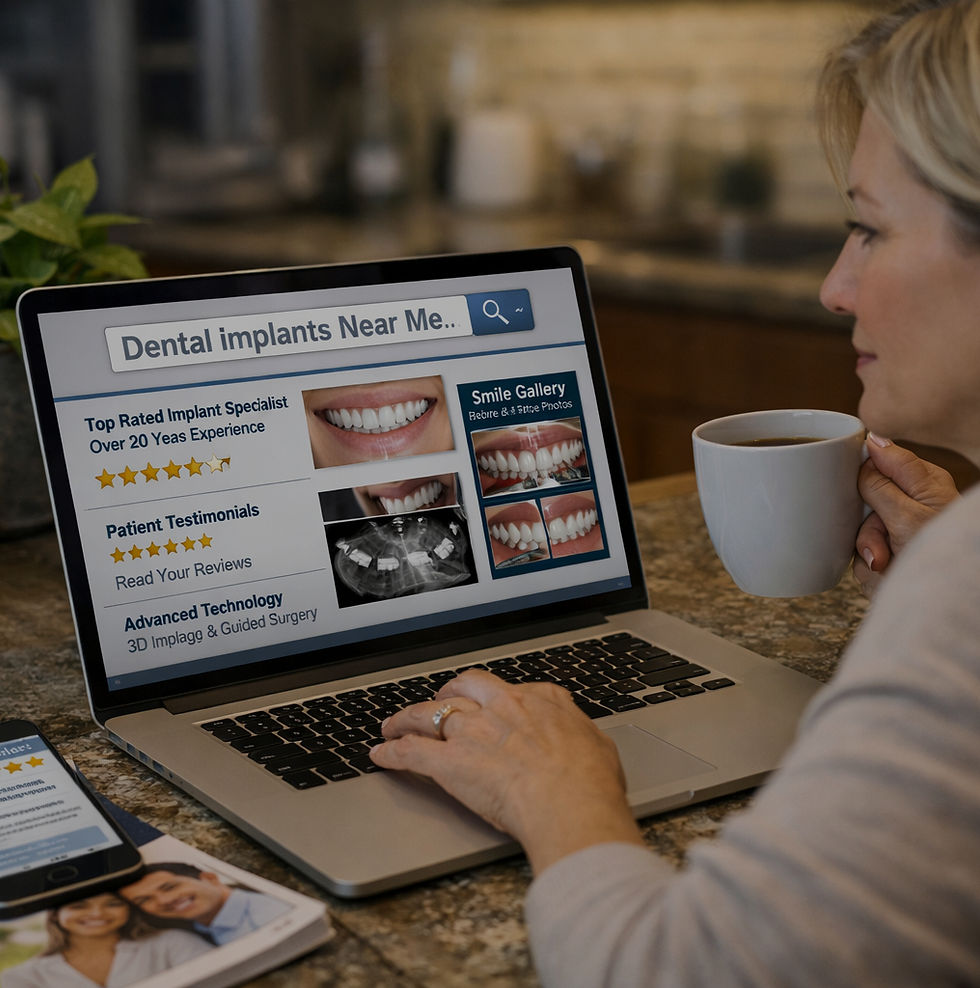
A person experiences a dental problem.
They learn about their problem and potential solutions from educational content on Google, YouTube, ChatGPT, etc.
They research potential solution providers and compare practices via their online presences, doctor credentials, reviews, etc.
They find a practice that meets their criteria, sufficiently reduces their fear/anxiety, and builds enough comfort and certainty to get them to contact and book an appointment.
What goes through the searcher's mind?
When your patients begin seriously considering a solution like dental implants, the process is not just of a clinical nature to them. It reveals itself as a voice in the back of their head, or a nagging feeling that builds over days, weeks, or months as they weigh what’s happening to their teeth and what it might mean for their future.
One moment they may feel out of control as they try to understand why a tooth failed or wonder what comes next after their tooth is extracted.
Looking further down the road, all of the financial and long-term implications may start creeping in, along with the fear of possibly making a costly mistake.
Sometimes the situation becomes more urgent because of pain, swelling, a broken restoration, or an upcoming event that suddenly puts pressure on their timeline.
For some people, the emotional turning point comes when their smile or appearance has taken a toll on their confidence.
Certain patients may also carry skepticism from past dental work that didn’t last as long as they hoped.
Not to mention the thought of surgery itself can introduce another layer of anxiety as patients imagine having to undergo sedation, unknown levels of pain or discomfort, long recovery times, and possible long-term complications.
And throughout all of that, patients often circle back to the same practical questions about the final result, if it will be worth it, and whether life will feel normal again afterward.
To help patients, you must understand what they're thinking and feeling.
Loss of control: “I need to understand what’s happening.”
Fear of making the wrong choice: “This might be expensive and permanent.”
Time pressure: "Will there be pain, swelling, broken restorations, looming events...?"
Aesthetic identity: “I can’t keep hiding my smile.”
Distrust from past dentistry: “I’ve been through this before.” "No more failed crowns/bridges."
Surgical anxiety: "Will I have to deal with pain, sedation, grafting, complications, or long healing times?"
Outcome obsession: “Will it look real?” “Will I chew normally?” "How will I feel?" "How long will it last?"
This is why self-directed search has become such a powerful patient pathway. By the time many patients reach out to a dental office, they’ve already been working through many these concerns on their own. That means the practices that attract them are the ones whose online presence speaks directly to those thoughts and addresses them before the first call is ever made.
Strategies for Self-Directed Searchers
Give patients clear reasons to choose your practice over others in your area. First, figure out what truly makes your approach different. It could be your advanced training, sedation options, niche expertise, technology, a uniquely supportive patient experience, or any number or unique value propositions. Once you know what makes you special, highlight that everywhere you can.
Create procedure-specific pages on your website that explain how implant treatment works at your office. These pages establish you as an informational resource and help patients find you when they search online for dental implant information or providers.
Publish educational content on your website that answers common implant questions. Topics like implant vs bridge, sedation options, and “Am I a candidate?” help patients understand their options and often lead to them visiting the practice that provided answers.
Design your website so implant patients can quickly understand their options and contact your office. Having a clean and modern design, patient-outcome-focused messaging, simple navigation, and many visible ways to call, schedule, or message helps patients take the next step.
Keep your Google Business Profile accurately filled out and optimized so implant patients can easily find and contact your practice on Google Maps. Steady inflow of reviews, photos, posts, correct information, and a simple “Call” button make it easy for someone considering implants to reach you.
Use professional photography across your website and online profiles to help patients feel comfortable with your practice before they visit.
Use video to explain treatments and introduce your team. Video is the most impactful tool in your kit to help patients get to know you and build trust before their first visit.
Run ads on Google and Bing so patients looking for implant solutions can quickly discover your practice.
Continue earning 5-star reviews from satisfied patients to build your reputation and credibility with people considering implant treatment.
Appear higher on Google by leveraging SEO (search engine optimization) so local patients who need your services can easily find you. A good SEO service should at minimum include having unique content written for your website on an ongoing basis, claiming and updating your listings in popular directories like Healthgrades and Yelp, adding helpful links between related content on your website (i.e., your main Dental Implants page links to your Full Arch page), having your webpages properly coded (i.e., title tags, meta tags, etc.), and incorporating background information (schema) that helps Google recognize the services you offer.
Make sure your website is also optimized to come up in AI-generated answers from Google AI, ChatGPT, voice search, and similar tools. As more patients get information this way, these references can guide them to your practice.
Provide helpful digital resources patients can explore while researching implants. Examples include downloadable implant treatment guides, short explainer videos, treatment timelines graphics, recovery checklists, or interactive tools that help patients understand their options.
Maintain a social media presence that helps patients feel familiar with your team. Share real patient success stories, educational insights, and behind-the-scenes glimpses of your office culture.
Track and record incoming phone calls to ensure implant inquiries are handled clearly and consistently by your team.
Self-directed search is the modern implant patient’s due diligence phase. Every potential new patient is, to some degree, comparing doctors and offices based on criteria such as experience with particular types of of treatment, patient reviews, before-and-after results, technology used in the practice, and whether the office simply feels trustworthy enough to call.
Fortunately, the patient who takes the time to research you is often already leaning toward treatment. At that point, what they find about your practice online will either give them the confidence to move forward with you, or nudge them to keep looking.


Comments